Underworld
Act 1: Descent & Death - How to Lose Your Hair in 33 Years
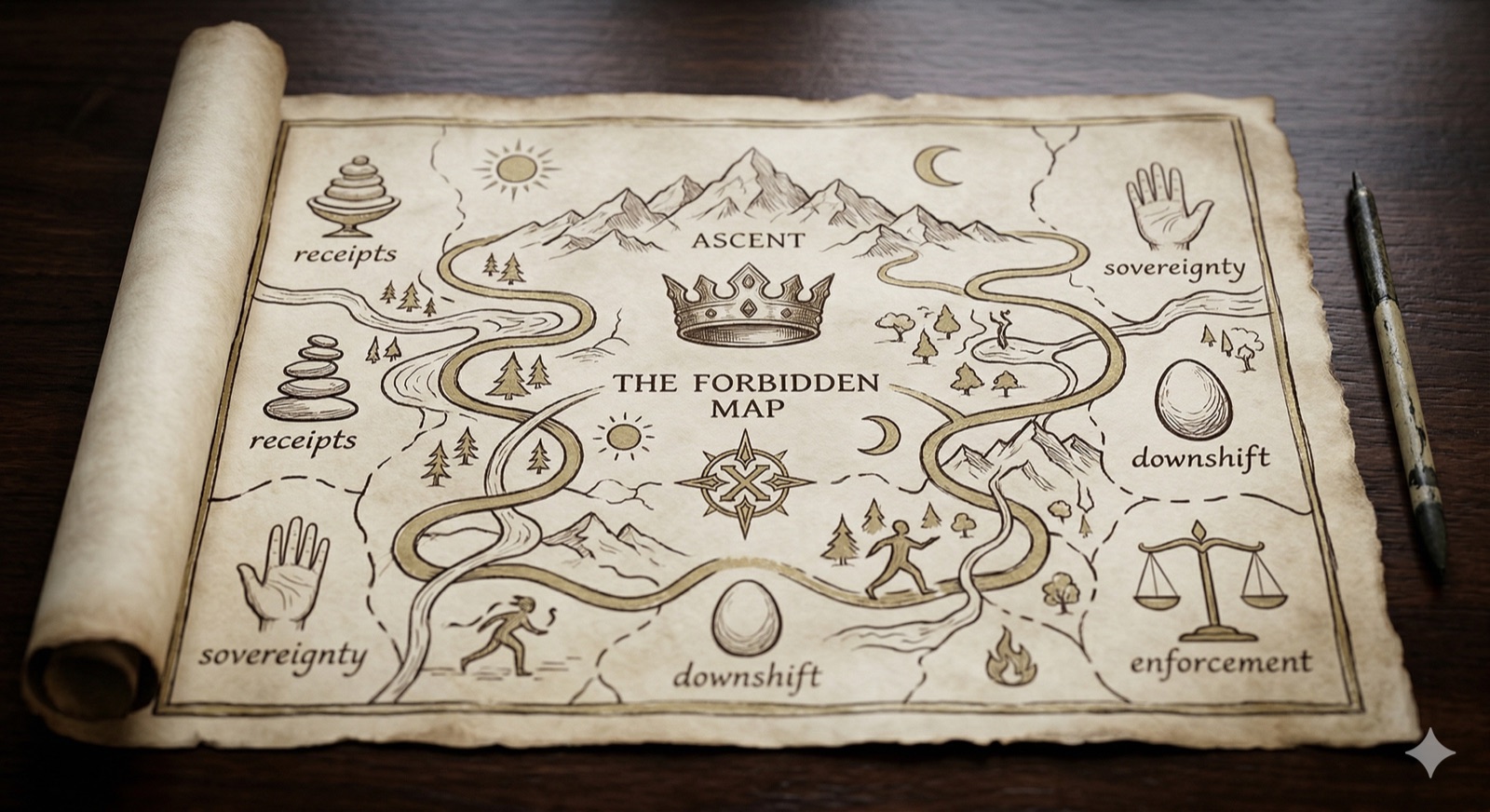
Hair loss is not the problem. Hair loss is the receipt. The descent story: pressure, performance, nervous-system war, and the crown as report.
Underworld
Hair loss is not the problem. Hair loss is the receipt. The descent story: pressure, performance, nervous-system war, and the crown as report.
How to Lose Your Hair in 33 Years The Labyrinth Nobody Sees
They tell you: “It’s just your DNA.” Or they sell you the new religion: DHT. One molecule. One scapegoat. One excuse to stop looking deeper.
And once you accept that story, you stop asking the questions that actually matter: what chronic pressure is doing to your hormones, what chronic overload is doing to your nervous system, and what your environment is doing to your body and rhythm—every single day, quietly, for years.
Hair loss isn’t the problem. Hair loss is the receipt.
Reader note: This series isn’t light reading. I worked two months on these five Acts and chose what’s necessary to understand the mechanics—without turning this into a trauma dump. I haven’t even scratched the surface of my story, and I don’t need to. If you’re not emotionally stable right now, don’t continue. Come back when you can read it with a clear nervous system.
For me it didn’t start as “bald.” It started as small betrayals—so small you can rationalize them. More hair in the shower. A crown that didn’t feel as dense. A hairline that needed more “styling” just to look normal. Nothing dramatic. Just a slow drift you can ignore until you can’t.
But here’s the part that should scare you: You can look disciplined and still be self-destructive. You can look put together and be burning out underneath. You can look “healthy” and be frying the system in private. And the hairline tells the truth long before you do. A lot of bald men aren’t unlucky. They’re living inside a war most people don’t even recognize—until the crown stops getting funded.
This is not a hair story. This is a descent story.
A slow collapse you can hide for years while looking fine on paper. It’s physiology under pressure. Not one villain—an accumulation. Not one catastrophe—compound interest.
Because if you call it destiny, you’re off the hook. But the truth is darker: you’re on the hook—inside a system that profits from your confusion and outsourced agency. The more you outsource, the more you buy. The longer you stay lost.
I lived it. And “Death” is when the mask stops working: the body won’t finance the performance anymore.
Looking back, the descent had a pattern. It didn’t happen randomly. It ran like a sequence—almost predictable:
That sequence didn’t start at 30. It started before I had language for it.
I was born into a family that looked mostly stable from the outside. But the storm came early, and my nervous system learned war long before I had language for it.
We came to a new country. I was born into that new world.
On paper it was a safe place. A big family. A new start. And then, when I was five, my father died. Life took a hit that doesn’t show up in family photos. People from our Christian community stepped in and helped, and because of that we could live in a house. From the outside, that looks like being held. Like security.
What outsiders miss is simple: a life can look “held” on the surface while the nervous system learns war underneath.
A mother in her late thirties, nine children, and no steady father figure in a foreign country is not a normal childhood. Even with extended family helping, that’s survival mode on steroids—constant load, constant roles, constant pressure. Not the kind of war you see in movies. The quiet kind. The kind that teaches a child to perform “okay” while something inside never fully powers down.
And it wasn’t one event. It was everything around it: the atmosphere, the responsibilities, the emotional gravity, the unspoken rules. When the storm starts before you can name it, it shapes you without asking.
Identity gets built around survival. Not around who you are, around what works. You don’t get to “find yourself.” You get trained.
You learn what gets you love. You learn what gets you punished. You learn what makes you acceptable.
That’s not childhood in a deep sense, that’s the mask being manufactured. And one small detail matters more than it sounds: I didn’t know how to express what was happening inside me. So I learned to perform “okay” instead.
And that’s the part nobody sees later. They see the man. They see the outputs. They don’t see the early system that produced them.
Before my story begins, there’s a longer one behind it.
My ancestors were proud German settlers who moved east in the era of Catherine the Great, and generations later they lived inside the Soviet Union. There, being German wasn’t a vibe. It was a rule: excluded by policy, blocked from society, and locked out of careers—especially anything tied to military supply or sensitive work.
And if you were Christian, that wasn’t a private belief you kept to yourself. That could make you a target. In some places, people were shot for it. That’s not ancient history to a nervous system. That’s a template for generational trauma.
Soviet-era exclusion doesn’t vanish when you move countries. It follows you quietly into your nervous system, in posture, in vigilance, in what your body expects from life.
People argue about “genetics” and ignore the inheritance that runs the nervous system: fear, hyper-alertness, survival wiring. You don’t just inherit genes. You inherit what your bloodline learned to expect from the world: pressure, suspicion, the need to adapt fast, the cost of being different.
Then you return to your “home country” thinking you’re finally safe—and back there you’re the outcast Germans. Then you’re in Germany and you become “the Russian.”
Meanwhile, my lineage is ethnically German. Welcome to the category circus. The funniest part is how confidently people label you while being wrong on the basic facts.
Too German there. Too Russian here. The body learns one lesson: you don’t belong.
That’s part of the unseen shadow. And it shapes the descent.
The first years of school were easy. I excelled. Then it got boring. And boredom didn’t just become restlessness—it became rebellion.
Not loud rebellion. The quiet kind. Stille Rebellion. The kind where you realize early: being sharp gets punished, being funny gets tolerated. So you become the class clown—not because you’re happy, but because it’s safer than being seen.
That creates an internal split.
I wasn’t the golden kid anymore. I became the villain. The black sheep. Everywhere. Not because I was “evil,” but because friction was the only thing that made me feel real.
Here’s the part most people miss: sometimes the shadow isn’t “I was wrong and I need to soften.” Sometimes it’s “I was right early, saw it clean, and got trained out of it.”
I had an early signal—sharpness, pattern-recognition, creativity, a social read, a verbal edge. And the environment did what environments do: it punished it. “Arrogant.” “Too much.” “Disruptive.” “Mean.” So the child learns a brutal lesson: if you want love, you dim the blade.
You bury the edge and build a “good” persona. But the buried blade doesn’t disappear. It mutates into sarcasm, resentment, a need to provoke, a need to win, a need to test limits—anything that gives you heat again when you’re not allowed to be honest.
That’s how people disappear into the collective: not physically—psychologically. They trade their edge for acceptance and call it “normal.”
And if you don’t resolve that early split, it mutates later: sarcasm, passive aggression, the need to provoke—anything but honest expression. Not because you want to destroy people, but because you want to feel power without permission.
So yeah. Mocking others. Pushing boundaries. Looking for conflict. Not because I wanted to destroy people—because I was trying to feel power without permission. That’s not a moral story. That’s a nervous system story.
And it’s also a factory, psychologically speaking. Not chains but conditioning. If you can train a sharp kid to self-censor his edge and call it “maturity,” you don’t need to restrain him. He’ll restrain himself. He’ll become competent, contained, useful, and non-threatening.
The perfect worker. Not the sovereign.
In my Christian community, I stood out — not as a saint, but as a problem.
Always questioning. Always resisting. Always restless.
I wasn’t built for blind obedience. And nobody knew what to do with a boy like that.
From the outside it looked like arrogance. From the inside it was misfit energy: I could feel something was missing, but couldn’t name it.
That early fracture created a pattern:
When the inner world doesn’t fit the outer structure, you either mature… or you numb.
I didn’t mature. Not yet. So I kept moving.
Over the years I tried every sport. Always in action. Always chasing the next high. Not for fun or for trophies—just to quiet the mind, to outrun what I couldn’t name.
Since adolescence, I loaded my scalp daily with chemical waste. Gels, sprays, shampoos—every day, for years. And the funny part? I never even dyed my hair once. I know guys who were under the same voltage—and on top of it they bleached and colored their hair for years. At the end there was even less left.
And that’s before you count the other chemical crap we put on ourselves with shower gel, perfume, sunscreen.
It sounds small until you understand what ‘small’ means inside a system.
Inputs accumulate, load accumulates, pressure accumulates. You don’t need one catastrophe to break a system—just enough ‘small’ for long enough to create drift.
Most men treat hair like decoration, but hair sits at the end of a chain: Inputs shape load. Load shapes hormones and inflammation. Those shape recovery and circulation—until the output changes. Hair is an output.
So while I was shaping identity, I was also loading the system—daily, quietly.
I broke out of the old structure. I didn’t find God in institutions, so I walked away. That’s where the boy ends, and where I begin. Built to survive, not yet built to thrive.
People romanticize leaving structure. They think freedom automatically becomes truth. It doesn’t. Freedom just removes the walls. What you build inside them is still on you. If you leave structure and don’t replace it with truth, you don’t become free—you just get absorbed by a different structure.
I could function. I could connect on the surface. But inside, most of the time, I was dissociated—present enough to perform, not present enough to live.
I didn’t replace the old structure with truth. I replaced it with numbing.
And I found a reliable off-switch for pain I couldn’t even name yet. From then on, a bottle was always close—quietly, constantly, like insurance.
I still carved a path.
After my technician training, I went back to school. Then engineering. Discipline. Achievement. The classic “get your shit together” arc. And from the outside, it worked. I looked like a man building something. I wore performance like armor and kept stacking proof that I was fine.
But here’s the line that should be tattooed into every man’s skull: the nervous system doesn’t care about your grades.
From the outside it looked like: “He’s doing well.” From the inside it felt like: “I’m surviving.”
I hit that wall early—the wall that makes most people switch degrees or quit. I didn’t quit. I forced performance back online with stimulation. Suddenly I could concentrate again. Output went up. Focus improved.
But relationships didn’t. Presence didn’t. Connection didn’t.
So the mask got sharper: performance up, connection down. Output up, presence down. High-functioning on paper, quietly fractured underneath.
And that’s the trade most men don’t notice until it’s too late: you can win on paper and still lose your life.
From there, the pattern started running me.
Unhealthy connections. Burnout after burnout. And I learned something most people refuse to say out loud: relationships aren’t just emotional. They set your nervous system’s baseline. If your life keeps you in threat, your body stays in threat. And a body scanning for danger doesn’t invest in luxury outputs.
The hits stacked quietly over time. And because I could still perform, nobody called it what it was.
People and society only calls it a problem when you stop producing.
So I kept producing. No one dramatic collapse. Just a long stretch of “fine” that wasn’t fine.
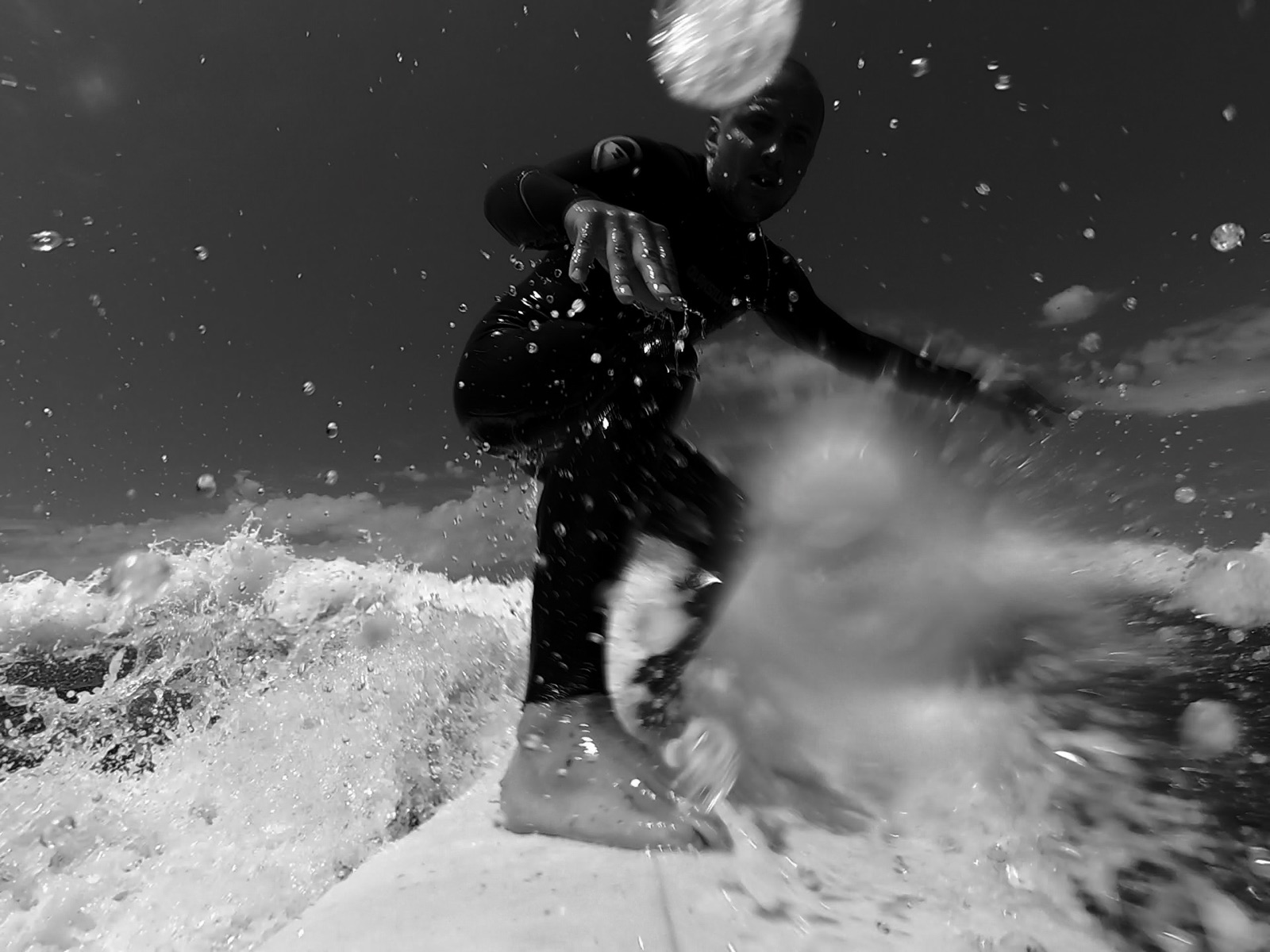
From the outside, it looked like life: training like a warrior, holidays, snowboarding in the mountains, surfing in the ocean. Movement without peace. Performance with better lighting.
But underneath it was a long series of micro-collapses disguised as life: career changes, relocations, new relationships, new plans. You don’t wake up one day and decide to destroy yourself.
You just keep choosing what works in the short term, until your whole system is built on survival strategies. And a system in war-mode doesn’t fund luxury outputs.
So the loop kept repeating: recover just enough to continue, push again, numb again. Intensity, collapse, repeat. Each time you call it normal, until “normal” is just burnout with a schedule. My normal state was burnout.
After my bachelor’s I told myself, “Now it’s done.” Three years later I was back at uni. Another degree. More effort. More pressure. More proving. But still no peace. Achievement became an identity patch, and a patch never heals the wound.
By 30, my body was showing it. Inflammation, dysregulation, and a nervous system that needed sedation to come down. Other receipts stacked up too: sleep that didn’t restore, gut issues, low-grade anxiety, and drive swinging, brain fog between spikes. Alcohol wasn’t a party anymore. It was a lever.
And the trap was almost invisible, because it looked respectable. Fitness and health science, and supplements became my religion. I ran the modern playbook like a loyal believer: more discipline, more protocols, more levers to pull. Anything—except the one lever that mattered: downshifting the system.
On paper I looked “healthy.” I bulked. I trained. I optimized. But it was just more noise. More pressure. More numbing. More stacks. More cortisol. More misalignment.
And the hairline is not impressed by your discipline. The hairline doesn’t care that you’re trying. It tracks physiology under pressure. Back then, I didn’t have the right OS. I had discipline without order.
I wasn’t a lazy man eating garbage all day. I wasn’t a caricature. I was a disciplined man still losing his crown.
Turning vegan around that time didn’t help either. It was me trying to outrun the same storm in a new costume. Trying to solve a system collapse with a new label.
New ideology. Same nervous system. New labels. Same load. New mask. Same war inside.
If your system is already in overvoltage, switching ideologies won’t restore rhythm.
I wasn’t “only a drunk.” And I wasn’t “only a fitness addict.” It was both.
One coping mechanism was aligned: a real instinct for health, movement, strength, structure. Something in me always wanted to build.
The other was misaligned: numbing, overstimulation, identity games, chasing external validation—anything that could keep me from sitting still long enough to feel what was underneath.
And that combination can fool anyone watching you. It fooled everyone around me. Even me.
Because from the outside, you look like you’re building. But internally you’re compensating.
This is where most people get it wrong: a behavior that looks disciplined can still be self-soothing. That’s why “just be disciplined” advice is dumb. Some men are disciplined because they’re free and aligned with their soul. Some men are disciplined because they’re trapped. Same behavior. Completely different engine.
And if your discipline is just self-soothing, your “success” is only a prettier cage.
You don’t lose hair overnight. You lose alignment one compromise at a time.
Not one big betrayal. A thousand small ones that feel harmless in the moment.
Less light. Less rhythm. More artificial everything. More stimulation. Less recovery. And because it’s gradual, you adapt to it. You call it “normal.” Meanwhile the nervous system stays on overvoltage.
You can still look put together. You can still be “disciplined.” And underneath, you’re burning out.
That’s the labyrinth nobody sees. That’s why this story matters. Because the labyrinth isn’t just bad habits— it’s misalignment and incoherence.
The man who can suffer. The man who can endure. But can’t rest. Can’t regulate. Can’t receive.
You can call it stress—but stress is too clean of a word. This was chronic war-mode: a system trained to survive, not to thrive. And hair does not thrive in war-mode.
Before my 33rd birthday, I hit rock bottom—and you could see it on the outside. Not because truth finally arrived. Because the mask finally cracked.
I used to laugh at the idea of trauma. “I’m the machine. I’m the man.” Then one trigger exposed what I’d denied for years: I wasn’t fine. I was dissociated, running on borrowed voltage—surviving instead of thriving.
The external structure destabilized fast. The mask stopped working. The body wouldn’t finance the performance anymore. And for the first time, I could see clearly. Like someone finally raised the blinds.
I was a wanderer. Lost.
And the scariest part? From the outside, it didn’t look like a collapse at first. It looked like a phase. It looked like stress. It looked like “just genetics.”
But it wasn’t destiny. It was a system.
The kind that can still function, still perform, still handles life—while quietly bleeding out for decades. And then one day, the compensation that’s been working for years finally broke down.
I was hopeless. I wasn’t trying to “win” anymore. I was trying to survive. I felt like I was going crazy.
There are timelines where I don’t make it out.
Here’s what was really happening underneath.
What destroyed the hair wasn’t one villain. Not genetics, not DHT, not stress alone, not food alone, not trauma alone. It was compounded pressure across the entire biological system, applied slowly enough to feel normal.
Chronic stress, overstimulation, and environmental load didn’t “hurt one thing.” They reshaped the whole signaling chain: brain, hormones, sleep, recovery. The nervous system stayed alert and reactive. The endocrine system followed: cortisol up, thyroid downshifted, insulin sensitivity drifted. Sleep got lighter. Appetite cues blurred. Recovery windows shrank. What many people miss: hormones don’t operate in isolation. They answer inputs. Light. Food. Toxins. Sleep. Training. Threat.
Alcohol, environmental toxins, artificial food, artificial light, and constant stimulation taxed detox pathways for years. A loaded liver doesn’t fail in a dramatic way—it prioritizes. And hair is never at the top of the chain.
Circadian rhythm broke next. Late screens. Late nights. Inconsistent wake-ups. Indoor days. Training and eating at times that made “results” possible but recovery impossible. Light exposure, sleep timing, hunger timing, and training timing fell out of sync. The system lost rhythm and without rhythm there’s no regeneration. Only survival management.
Then “optimization” became another stressor. More tracking. More stacks. More intensity. Less recovery. Discipline without alignment kept the system inflamed and reactive. Over time micro-circulation downgraded. Inflammation stayed elevated. Repair lagged behind damage. And at that point the body made a rational trade: when survival is expensive, luxury outputs get cut.
Hair wasn’t attacked—it was deprioritized. The hairline didn’t fail. It documented the cost.
That’s the part most men never get told: hair loss isn’t the beginning of the problem. It’s the receipt at the end of a long system collapse.
This isn’t a motivational story. It’s an exposure. Because most men are being handed a clean, convenient narrative:
“It’s just genetics.” “Nothing you can do.” “Accept it.”
And if you take that story, you never have to look at the real one.
My body documented what I kept minimizing: pressure, drift, numbing, overvoltage, the mask. But the descent I lived wasn't destiny. Or maybe it was—so I’d finally see the labyrinth clearly enough to name it. And eventually, carve the lens that could read it.
If this feels like you— if you’re disciplined but tired, if you “optimize” but don’t recover, if you can’t fully rest, if your body keeps dropping signals—hair included— and you’ve been told it’s just fate…
Stop calling it destiny. Stop hiding behind genetics and DHT panic culture. Start seeing the labyrinth.
Most men think the labyrinth hides the Philosopher’s Stone. A hack that turns decay into gold. But the stone is forged, not found: rebirth first, restoration second, then the rebuild becomes inevitable.
Because once you see it, you can’t unsee it. But seeing the labyrinth isn’t the exit.
Awareness doesn’t restore anything. It’s just the crack in the egg.
If you want the deeper picture, you’ll understand why I had to write this as five Acts—I could do a book or more. Health and training have been in my system for nearly twenty years. The last four years I went cross-domain—biology, nervous system, psychology, pattern recognition—until the pieces stopped contradicting each other. I didn’t plan to find this. I haven’t even searched for a solution. I was ready to fly to Turkey like everyone else.
In the next Acts you’ll see what actually rebuilt the machine, and how the crown changed once the inputs changed.
CROWN ALCHEMY The Five Acts
Act I of V: This is how the war was built. Act II of V: This is how the war ends inside. Act III of V: This is how the war is sold to you. Act IV of V: This is the machine that replaces belief. Act V of V: This is the run. The receipts. The coronation.
Next week: Act II of V REBIRTH. RESTORATION. How to Regrow Your Hair After 33 Years. The Egg. The Narrow Gate.
ResourcesPrivacy Settings
This site uses essential storage and optional usage measurement. Privacy Policy