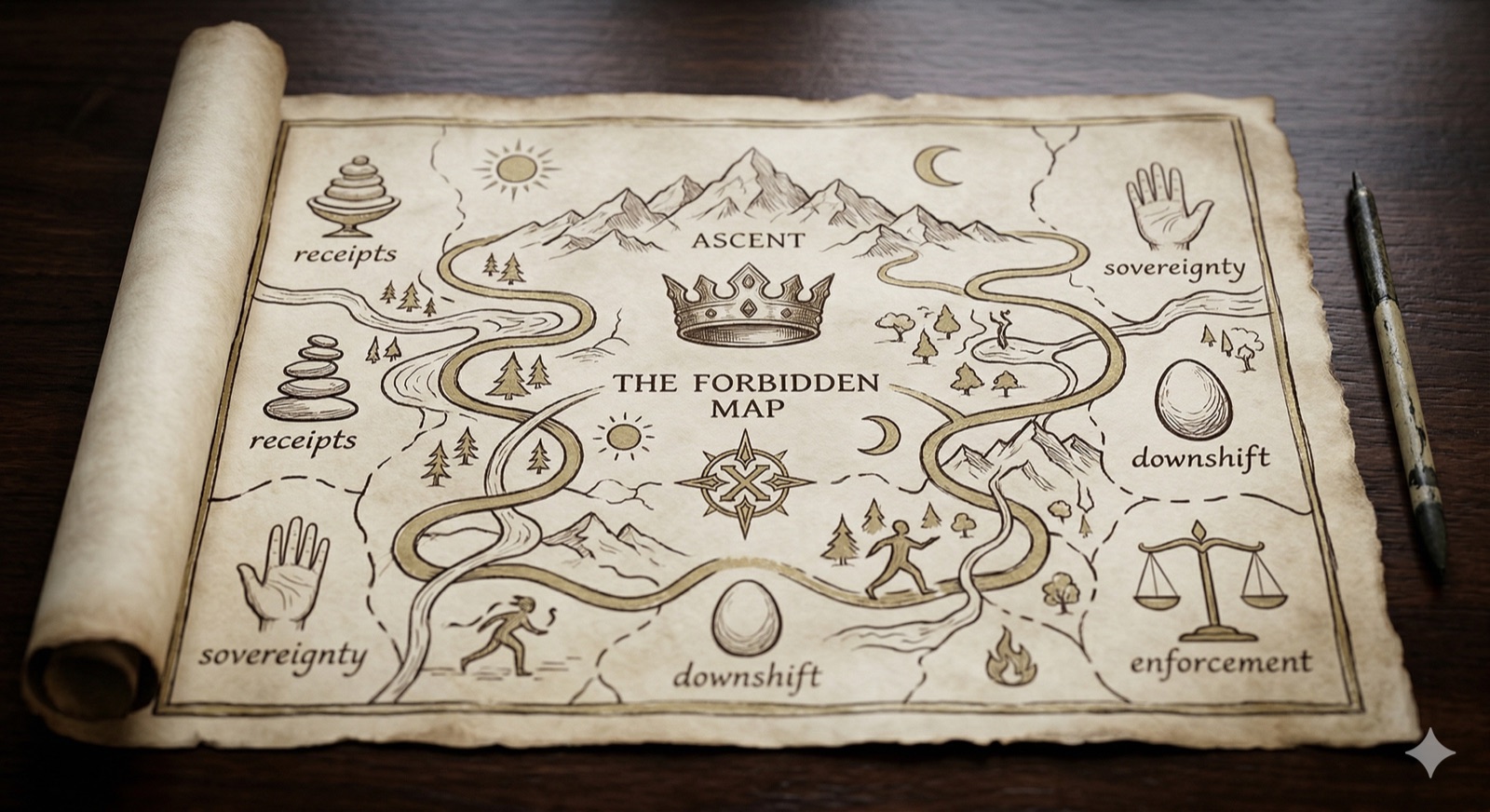
Terrain
Act 2: Rebirth & Restoration - The Egg. The Narrow Gate.
Restoration starts before hardware. Breath, safety, signal, and the compass returning before the body can use any protocol.
Terrain
Restoration starts before hardware. Breath, safety, signal, and the compass returning before the body can use any protocol.
How to Regrow Your Hair After 33 Years. The Egg. The Narrow Gate.
Most men will never hear this. Not because it’s too complex—because it forces responsibility where it’s easier to hide behind genetics, DHT, or “bad luck at birth.”
And it starts where most people refuse to look, even though it matters most. This is an inside job first. My regrowth didn’t begin with a fancy protocol. Restoration doesn’t begin with hardware—food, training, protocols.
Act II is the gate: safety, signal, and the compass returning. In Act I, the receipt was a warning—not because I was lazy, but because I wasn’t in coherence. That’s the difference most men miss.
Most people think the story starts at rock bottom, when the damage is visible. But my healing journey started earlier.
I didn’t even have the language for it until 2025, because the first shift wasn’t diet, and it wasn’t a hair solution. It was my breath.
When you’re diving, you give a signal when you’re running out of air. I was that guy in the diving group who had to give the signal first. Twenty-five minutes in and my oxygen tank was empty. The group had to cut the dive early because my system couldn’t hold it. And it wasn’t bad fitness. It was something deeper: a nervous system that couldn’t downshift under pressure.
It was the first time my body exposed the real problem: A nervous system and breath that couldn’t regulate.
Back home, I started doing things I didn’t fully understand yet. Trying to downshift with autogenic training and yin yoga. And after some of those sessions, I’d feel this sudden wave of clarity—almost ecstatic—like my whole body lit up, colors looked vivid again, and energy started moving through me instead of being stuck.
And that’s where the story actually turns: the stored overvoltage I’d been carrying for years finally started to discharge.
You don’t realize how much tension you’ve been living in until your body finally releases a fraction of it. That was my first proof that the body doesn’t argue. It releases.
Everything started with a breath. From then on, I kept practicing—on and off—without knowing it mattered.
Right before the bottom, I already knew something brutal: the life I was living wasn’t mine.
So I pulled the sedatives: alcohol, weed, cheap dopamine.
Not to level up, not to impress anyone—just to see what was left when the numbing was gone. I replaced escape with motion. I was still functioning, still training, still moving through days like a disciplined man. But without sedation, the backlog started surfacing.
Rock bottom didn’t teach me that I was lazy or weak. It taught me something worse: I was out of alignment. My engine was running, but the driver wasn’t home. The old identity could still produce, but it couldn’t run the machine anymore.
Back to 2022. If you read Act I, you’ve already seen the frame. The last frame you saw was real.
I hit rock bottom. My life fell apart and you could see it on the outside.
Not because the truth finally arrived. Because the mask stopped working.
I lost most of my old friends. Not because they were evil. Because that kind of darkness is a mirror and a lot of people can’t hold it. They don’t know what to do with a man who’s no longer pretending everything is fine.
I was lucky I had a roof over my head. Truly.
And this is where most men get trapped: they try to solve inner misalignment with explanations. They look for the right story, the right label, the right reason—anything to avoid the deeper work of reconnection.
So I did what you’re “supposed” to do when you have psychological issues.
I went to therapy, because that’s what you do when your inner world starts breaking open and you don’t have orientation. But the truth is, she was trained to connect with the DSM, not the human soul. I was moving through something deeper — a spiritual awakening, an initiation — and she was trained for CBT workflows, symptom management, and re-stabilizing the surface.
At one point she looked at my life on paper and said, almost impressed: “Your CV looks great. Someone with trauma wouldn’t have been able to do all that.” That sentence hit me like a verdict, because it revealed the frame. The assumption was: if you can perform, you must be fine. If you can achieve, you couldn’t possibly be carrying something unresolved. Output as proof of health.
Then came the labels. She handed them out like trading cards — OCD, ADHD, “high on the spectrum.” Scores, categories, names. And I’m not saying labels are useless. A label can point at behavior, but it can’t restore a broken compass. And the system loves labels for the same reason it loves any form of outsourced authority: once you accept the label as identity, you keep outsourcing and your inner compass stays offline.
So I’m going to say it clean: it wasn’t even that she “helped me talk.” The whole process felt like a route back into the old program — symptom management, functioning, coping — back asleep in the matrix, with labels as sedatives.
What I needed wasn’t sorting symptoms. What I needed was reconnection.
Back into my body. Back into my spine. Because without reconnection the body stays in threat — and a body in threat kills luxury outputs. Modern psychology often trains people to identify with their wounds, to become professional narrators of their pain, and live a life as a victim. It rarely makes a man whole.
And I wasn’t looking to manage a story. I needed to become whole. I needed to rise as a man. I needed to transcend — not in theory, not in concepts — but in my nervous system, in my choices, in what I tolerated, and in what I stopped tolerating.
Insomnia. Thought-loops. Flashbacks. The kind of nights where your body is exhausted, but your nervous system refuses to stand down. Your mind keeps replaying the same scenes, the same questions, the same dread — like it’s trying to solve something it can’t solve with thinking.
That’s when meditation entered my life, and not as a trend. Not as “wellness.” I wasn’t meditating to become a calmer person on Instagram. I meditated because otherwise I couldn’t sleep. Meditation wasn’t a feel-good hobby. It was a survival mechanism. A way to create even a small pocket of stillness inside the storm.
And that’s what I didn’t understand yet: this is where the signal starts returning. Presence. Breath. Body. No distractions. No performance. Just the raw data of what’s actually happening inside you.
I had always read to learn, but something shifted in that season. Reading stopped being “education” and became a lifeline. I wasn’t consuming self-help as entertainment. I wasn’t collecting inspiration like dopamine. I was reading like a man trying to survive his own mind without numbing it.
I tried stoicism first — the classic move: function without healing. Been there, done that. No thanks, Marcus. Then philosophy. Then deeper work. Not because it was fashionable, but because the surface explanations weren’t enough anymore—and I could feel it.
Inner child work. Trauma frameworks. The Body Keeps the Score. C-PTSD. ADHD. The Road Less Travelled. Different languages pointing at the same reality: what’s stored doesn’t disappear because you understand it. It has to move.
So I started doing the simple things that don’t look heroic but change everything. I sat in silence. I walked in nature. I learned to breathe — not as a technique, but as a way back into the present moment.
And slowly something came back online:
Presence. The ability to sit in my own body without immediately escaping.
I connected deeper with myself. And for the first time, I could start connecting better with the people around me — not performing, not explaining, not managing impressions.
Actually being there.
There’s a quote that did more for me than therapy ever did. Not because it was poetic, but because it was honest:
“Der Vogel kämpft sich aus dem Ei. Das Ei ist die Welt. Wer geboren werden will, muss eine Welt zerstören.” Hermann Hesse, Demian.
“The bird fights its way out of the egg. The egg is the world. Whoever wants to be born must destroy a world.”
That’s rebirth. You don’t renovate the old world. You don’t negotiate with it. You don’t “heal” it with prettier habits. You break it — because the old world is the cage. And as long as the cage stays intact, you stay intact in the same way too.
That line stayed with me for years, because it didn’t treat me like a diagnosis. It didn’t reduce me to symptoms and categories. It treated what I was living through like an initiation — the kind that asks something from you, not the kind that excuses you.
Demian helped me search for my place in the world because it mirrored the thing I couldn’t explain yet: that the collapse wasn’t random, and the discomfort wasn’t a mistake. It was the pressure of something real trying to be born.
Not comfort. Not labels. A mirror.
And once you see that, you stop asking, “What’s wrong with me?” You start asking, “What has to die—so something truer can live?”
I was already in top physical shape for my age. The problem wasn’t effort. It was missing governors—the invisible rules that decide whether the system can actually recover.
And no, I didn’t just read poetry and psychology.
I went obsessive.
Neurochemistry. Brain development. Neuroplasticity. Hormones. Dopamine. Cortisol. Stress physiology. The mechanics behind mood, sleep, drive, focus—what actually moves the needle when the mind won’t shut off and the body won’t settle.
Podcasts ran on loop while I walked through parks and along riverbanks. Not as entertainment, but as survival research. Because I couldn’t hide from it anymore: dopamine and cortisol were never “just fitness topics.” They were running the whole machine.
And my machine was out of balance.
So I kept feeding my subconscious—study after study, framework after framework—without realizing what I was really building. Not answers. A lens. Pattern-recognition. A way to see cause and effect instead of chasing symptoms.
That’s the paradox of that phase: you think you’re collecting information, but you’re actually sharpening a blade.
And when cosmic insight meets a mind full of mechanisms, it becomes dangerous—not in a dramatic way, but in a truthful way.
The real shadow work wasn’t reading about psychology and feeling smart. It was action, where the theory meets reality.
I took a career change I’d been afraid of for years. And for a moment it looked like I was “back on track.” But it still didn’t hold, because the move was built on an outdated belief: that I wasn’t positioned for the future.
I’m an engineer with a craftsman’s foundation. I built systems with robots. I advised major companies in R&D. From the outside, that should’ve been enough. Inside, it wasn’t.
So I kept climbing on paper: consulting, IT project management, projects, work, structure. I was good at systems—until it hit me that I was building the wrong ones.
I know what real work looks like. I know what competence feels like and I can spot performance too. After a few months, the facade was obvious. Too much status and ego theatre. Too much talk. Not enough truth. And once you see that clearly, you can’t unsee it. I could feel the difference between building something real and being inside a machine that runs on optics.
In reality I was off-path. And the body knows.
And here’s what mattered more than any career move: over time, the conditioning loosened. Not in one breakthrough moment. More like a knot slowly giving way.
The noise dropped. The constant second-guessing softened. And something I hadn’t felt in years came back online: a calm trust in my own read, in my own capability, in my own sense of what’s real— and in what I could build once I stopped bargaining with myself. A quiet certainty. The kind where you don’t need permission, and you don’t need applause. You just see clearly again.
This time, I didn't drive myself into burnout. I pulled the handbrake without having anything new lined up. I didn't want to play into society's fear loop anymore.
On some island in 2023, a ceremony cracked something open again. Not a collapse like early 2022. A confrontation.
It forced the bigger question I couldn’t outrun anymore: Where is your place in the universe? What does your soul actually want? What is your “Way of the Superior Man”?
And I knew it couldn’t be what I was doing—especially not consulting pharma businesses in IT. So I left.
I came across Jungian psychology. Finally, a language that could hold what the DSM couldn’t — symbols, shadow, projections, meaning, soul.
I started reading and releasing more of what had been holding me back. I started mapping my patterns — my story, my inner world, the parts of me that kept repeating even when the surface changed.
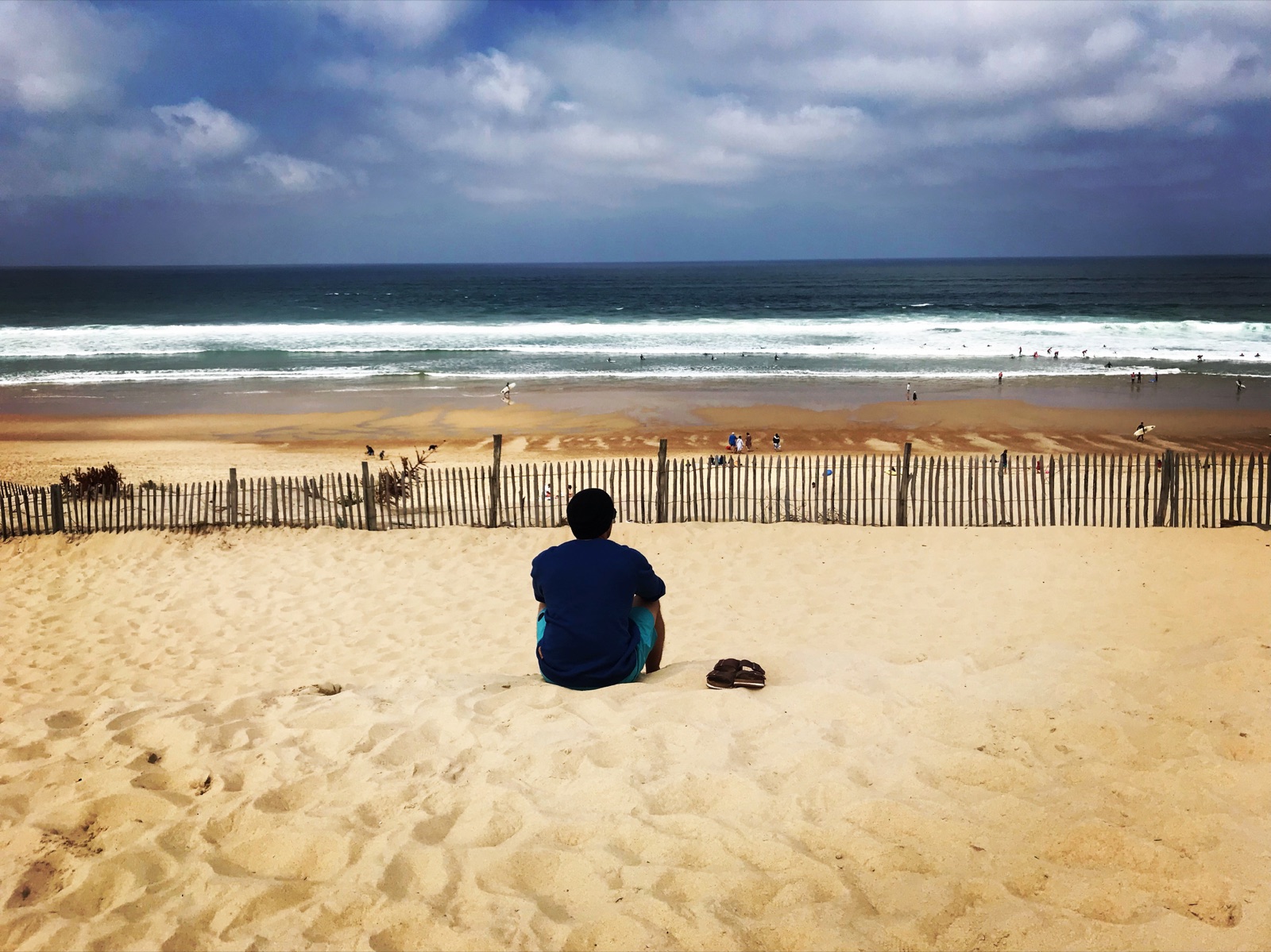
That summer I spent a lot of time on the Atlantic coast, mostly alone. I had the space to recharge, to surf, to stay close to the ocean—long enough for the noise to drop and the deeper questions to get loud.
By then I was questioning everything in my life. Not just jobs and relationships — even my hobbies. Even piano, which I started in 2020. Why did I start it? Who was I trying to become? What still felt real now? And what was just a costume from the old world?
I didn’t want to drift back into survival mode and call it “normal.” So I made an autonomy move: sales, freelance. Not for status. Not to grind. For freedom and time — so I could actually explore myself deeper, without pretending the inner work was optional.
Right around that time, the story started breaking.
By then I’d already lived every modern costume. I had my gymbro phase. My biohacker phase. My academic phase. I was the guy who knew it all or at least knew enough to sound like I did.
I had already achieved the surface milestones too. Six-pack. Strong lifts. “Healthy” on paper. And still, the system wasn’t safe.
That’s when the first external shift finally happened. I stopped being vegan. I stopped with synthetic crap. Not as a trend, not as a new identity — just as a quiet refusal to keep stacking inputs that didn’t feel clean anymore.
The deeper rebuild was coming. I just didn’t have the final OS yet.
Everyone loves to talk about how the body can heal itself. Autophagy. Neuroplasticity. Placebo. Mind-body. All the sexy words.
But when it comes to hair, they suddenly shut up.
“Genetics.” “Just shave it off.” “Get over your ego.”
And I couldn’t take that seriously, because I’d already lived the “shave it off” path. I shaved my head half of my childhood. Then I lived bald for eight years straight. So this was never about vanity. It was never about trying to win some beauty contest.
It was about truth.
And I finally understood: there was more to the story. This wasn’t a scalp problem. It wasn’t a “bad luck at birth” problem. It was a deep structural health problem — a whole-system problem that shows up in the crown because the crown is an output.
I wanted more than surface milestones. I wanted coherence. I wanted the real lever. I wanted to reverse the direction.
The obsession wasn’t random, it was the moment the loop closed. I had been sharpening a lens for years—and once the pattern snapped into focus, I couldn’t pretend not to see it. And if you’re honest, you don’t get to keep living the old lie.
And I didn’t even realize yet: I’d already done a large part of the work — bit by bit — just to reach the threshold.
Then the universe stopped negotiating. Retreat wasn’t a choice anymore. It felt like life answered a request I hadn’t said out loud.
A routine moment turned violent in half a second. I went down hard and my wrist was wrecked. From the first moment I sat in the ambulance, I knew this wasn’t random. There was a bigger plan behind it. The emergency doctor was almost shocked by how calm I was. He told me he rarely sees that.
There are timelines where I don’t make it out.
Thanks to my reflexes, it wasn’t worse. But something else hit harder: I wasn’t alone. Someone was watching over me, and I realized: “Though I walk through the valley of the shadow of death, I will fear no evil: for thou art with me.”
My arm was in a cast and splint for almost three months. On a scale of complexity from 1–9, it was an 8. They didn’t fix it. They had to rebuild it. Nine screws were set into a small area.
For months my right hand was useless. No training. No piano. No normal life. And for the first time in my life, I couldn’t outrun anything. I couldn’t escape through movement anymore.
That forced stillness changed the entire game. Restoration stopped being an idea. It became law.
I wasn’t living in chaos. I was already disciplined. By external metrics, I was fine—already “healthy” by most people’s definition. And I was more aligned with deeper parts of myself than ever.
But law is different than a goal.
Restoration became law meant I stopped treating life like a set of approved compartments. Not fixing one corner while ignoring the rest. Not staying inside the old frameworks just because they were familiar, socially acceptable, or stamped as certified.
It meant the work moved into the shadows—into a forge.
I refused to keep living inside borrowed frameworks. I was looking for what’s true underneath explanations.
And I refused to keep outsourcing reality to templates that never had to carry my nervous system, my body, my soul. Because I could see the trap: if the story is “genetics,” the conclusion is surrender. If the story is “one molecule,” the conclusion is dependency. I could see through that. So I made a decision—no more borrowed stories.
I was interested in conquest: of the lie, of the spell, of the puzzle.
I had spent years collecting pieces—training, hormones, sleep, stress physiology, nervous system work, environment, rhythm, recovery, psychology, spirituality, the grift economy around “health,” the stuff that actually moves the needle and the stuff that’s just theatre. Most people collect one piece and turn it into a religion. I refused that.
Restoration became law meant I was going to bring the pieces together until the pattern snapped into one coherent picture—one sequence that could actually be lived. Not a belief. Not a label. A usable framework.
From there, I became willing to touch everything—mind, nervous system, environment, relationships, habits, beliefs, recovery, rhythm, body. Not because I needed a makeover. Because I wanted a standard of health and truth that went beyond what most people even consider real.
I went obsessive—not in despair, but in devotion. Not to be “more optimized,” but to be more true. I studied deeper. I tested deeper. I watched myself closer.
I wasn’t doing it with drama. No self-pity. No quitting. Just a quiet, uncompromising seriousness: if something was false, it had to burn. If something was real, it had to hold. And once I crossed that line, there was no going back to the approved story.
And in that silence, something started pointing. Not a new opinion—direction.
The bird was ready to leave the old world.
I wasn’t looking for motivation. I was looking for truth. And I was willing to go past what most people would call “excessive” just to live it.
Here’s what most men refuse to understand:
You don’t “think” your way out of war. You discharge it.
All the load my nervous system had been carrying for years had to surface. Not as a theory. Not as a story I could tell well. It had to be felt in real time, moved through the body, and released. Integrated. Not explained away.
Because stress and trauma aren’t just “mental.” They’re physical patterns. They live in breath, fascia, tension, posture. In old injuries. In early wiring. In survival responses that quietly become your default settings. A body that stays braced even when nothing is happening.
Back in 2019, I didn’t have clean language for any of this yet. I just noticed the constraint: I couldn’t downshift. So I started reaching for regulation without calling it that—autogenic training, yin yoga, anything that could lower the voltage.
The more I paid attention, the clearer it got: the mind can narrate forever, but the body keeps the actual score. Somatic release was the work. The body discharging what the mind couldn’t intellectualize away.
Stress doesn’t vanish because you get spiritual. Trauma doesn’t disappear because you can explain it. A system trained for war can still function, still perform, still look impressive—while never fully entering repair.
And a system that never enters repair does rational trade-offs.
If the nervous system lives in threat, hormones follow. And hair follows hormones.
That’s the bridge most people refuse to walk, because it puts responsibility where most men don’t want it: not just on the supplement stack, not just on the next protocol—but on your internal state, your baseline, your ability to signal safety to your own biology.
And something else came back online when the system finally started to downshift: Intuition.
When the inner war starts discharging, something returns that most men have trained themselves to numb. A quieter layer of knowing. The part of you that can feel truth in the body before the mind starts bargaining. The part that recognizes alignment the same way you recognize a wrong note—instantly, without needing an argument.
That’s where God entered the story. Not as an idea I had to defend, and not as a costume I could wear. More like guidance that showed up when the old identity was dying and the new one wasn’t fully formed yet. A higher axis cutting through the noise. Not a constant voice—just unmistakable moments of direction, arriving with a kind of clarity that didn’t come from research.
Because when you live in overvoltage, intuition gets buried under noise.
You call anxiety “drive.” You call restlessness “ambition.” You call survival “discipline.”
And for years, I couldn’t trust my own direction. On paper I was climbing. In real life, I was drifting. So I did what most people do when the compass goes offline: I outsourced. Experts. Tribes. Protocols. Certainty. Anything that felt solid enough to stand on.
But as I downshifted, the compass returned.
Not in one dramatic breakthrough. In small, consistent signals. I started noticing what expanded me and what contracted me. What brought peace and what quietly kept me in threat. What was life—and what was performance. What was truth—and what was just another mask wearing a new name.
And that’s what restoration really is.
Not stacking more hacks. Not chasing the next fix. Not collecting “right answers.” It’s getting your inner compass back.
Because without it, you’ll keep chasing solutions that look smart and feel dead—and you’ll call the confusion “research,” while the body keeps paying the cost.
Men love awakening or enlightenment as an idea. A concept you can talk about, post about, identify with. But the soul doesn’t live in ideas. The soul expresses itself through an avatar. Through a nervous system. Through a body that either feels safe enough to build—or stays armed, scanning, bracing, conserving.
And a tormented body keeps the mind locked in threat.
That’s why “structural health-maxxing” isn’t vanity. It isn’t aesthetics. It’s temple work. It’s building an organism the soul can actually rest inside. Because when the body is constantly broadcasting danger—through breath patterns, posture, tension, a locked jaw, a braced diaphragm, old injuries you never resolved—your mind doesn’t get to be free. It gets recruited into management. Into vigilance. Into coping.
Stress isn’t “in your head.” That’s too clean. Stress is stored.
It’s stored in breath. In posture. In fascia. In old injuries. In the nervous system you built as a kid. Trauma. Accidents. Sports damage. Years of bracing. Years of threat becoming normal until you don’t even notice you’re braced anymore—you just call it your personality.
And what’s stored doesn’t disappear because you understand it. You can read a hundred books and still carry the same tension in your chest. You can name every pattern and still wake up with the same jaw clench. You don’t think your way out of war. You release it.
Because when the system lives in overvoltage long enough, you lose the compass. And a man without a compass becomes easy to sell to. Genetics. DHT panic. Stacks. Shortcuts. New villains, new saviors, new protocols—anything that lets you outsource what you can’t feel inside yourself.
But the crown doesn’t return to a man chasing noise.
It returns when the inner war ends. When the system finally gets a real signal of safety—enough safety to shift into repair, enough safety to create surplus again. Safety is upstream of hormones. Hormones are upstream of hair.
That’s why hair is not an isolated battle. Hair is the receipt.
And no system that feels unsafe will fund luxury outputs. No safety, no luxury.
The labyrinth is what happens when life is built around threat. Not just obvious chaos—subtle threat. The kind that hides inside “normal” routines. Inside a rhythm that’s off by just enough to keep you wired. Inside an environment that quietly taxes you. Inside identity and coping and survival strategies that work well enough to keep you producing, but not well enough to let you heal.
And when you live like that long enough, the body adapts. It learns the baseline. It treats overvoltage as home.
That’s why the labyrinth is so hard to see from the inside. It doesn’t feel like a crisis. It feels like your personality.
But once the inner war starts discharging, something changes. The same inputs start landing differently—because the system finally stops fighting back. Not because you found a new belief. Because you lowered the load.
And that’s the part most people miss: The gate was never more information. The gate was safety.
The first guardian is internal. Your capacity to downshift. Your ability to tell your nervous system, with real signals, not affirmations: stand down. We’re safe enough to repair now. That’s the Narrow Gate.
Because if your nervous system never stands down, nothing holds—discipline, diet, routines, protocols. You can “do everything right” and still sabotage every plan you touch, then call it genetics. Not because you’re weak. Because you’re trying to build on a nervous system that’s still broadcasting danger.
The Narrow Gate is regulation—and connection to something higher than panic and performance. A higher axis that makes coherence possible again.
When you live in threat long enough, you stop trusting your own read. And once you lose signal, you become easy to program—by fear, shortcuts, and external authority. So you outsource authority. Because you can’t feel what’s true anymore.
That’s why Act I mattered. In Act I, I called it physiology under pressure. Act I showed the collapse.
Act II didn’t fix the crown. It stopped the bleeding in the control room. It showed the gate: safety becomes non-negotiable—because without safety, the compass stays noisy.
That’s the difference between a man “doing everything right” and a system that can actually repair.
So Act II is the initiation that makes any move usable: restore safety, restore signal, and get the inner compass back online.
We’re not out of the labyrinth yet. But now you can feel direction again.
And that’s where Act III begins. The Spellbreak. Not building a new tribe. Not yet. Seeing the labyrinth as a structure—and refusing to rent your compass back from it.
Next: Act III of V SPELLBREAK. SOVEREIGNTY. The Labyrinth Economy. Refuse Priesthood.
ResourcesPrivacy Settings
This site uses essential storage and optional usage measurement. Privacy Policy